The NSF CAREER Proposal is an excellent way for faculty to jumpstart their career. It acts as a five-year slice of a PI’s career goals and covers everything from research to education to broader impacts plan. Not only is this award prestigious, it is a great way to build a foundation for strong proposal writing helping PI’s create a tradition of proposal success to drive them for future endeavors. Over the years, the College of Engineering Office of Research Innovation’s Research Services team has amassed a lot of knowledge and resources pertinent to the NSF CAREER Proposal. If you are interested in other early career opportunities, click HERE.
How can we help you?
Project Description Resources
This is an accordion element with a series of buttons that open and close related content panels.
Specific Webinar & Presentation Segments
We have reviewed the NSF Project Description in depth in multiple webinars and presentation. Use the below resources for our advice and guidance on writing the bulk of your project description.
Detailed Project Description Outline
DOWNLOAD THE DETAILED PROJECT DESCRIPTION OUTLINE
Research and Education Goals [1-1.5 page intro/overview]
|
Proposed Research Plan [7-9 pages]
|
Proposed Education Plan [3-5 pages]
|
| Optional: Intellectual Merit [1 paragraph]:
Briefly summarize how your research and education platform will further advance scientific knowledge. Consider:
|
Optional: CAREER Development Advisory Committee [1 paragraph]
|
PI Qualifications [1 paragraph]
|
Project Schedule [Gantt chart or similar timeline figure]
|
Results of Prior Support from NSF (if applicable) [1 paragraph]
|
| Broader Impacts [1 paragraph]:
Briefly summarize how your research and education platform will impact and improve specific, desired societal outcomes. Consider:
|
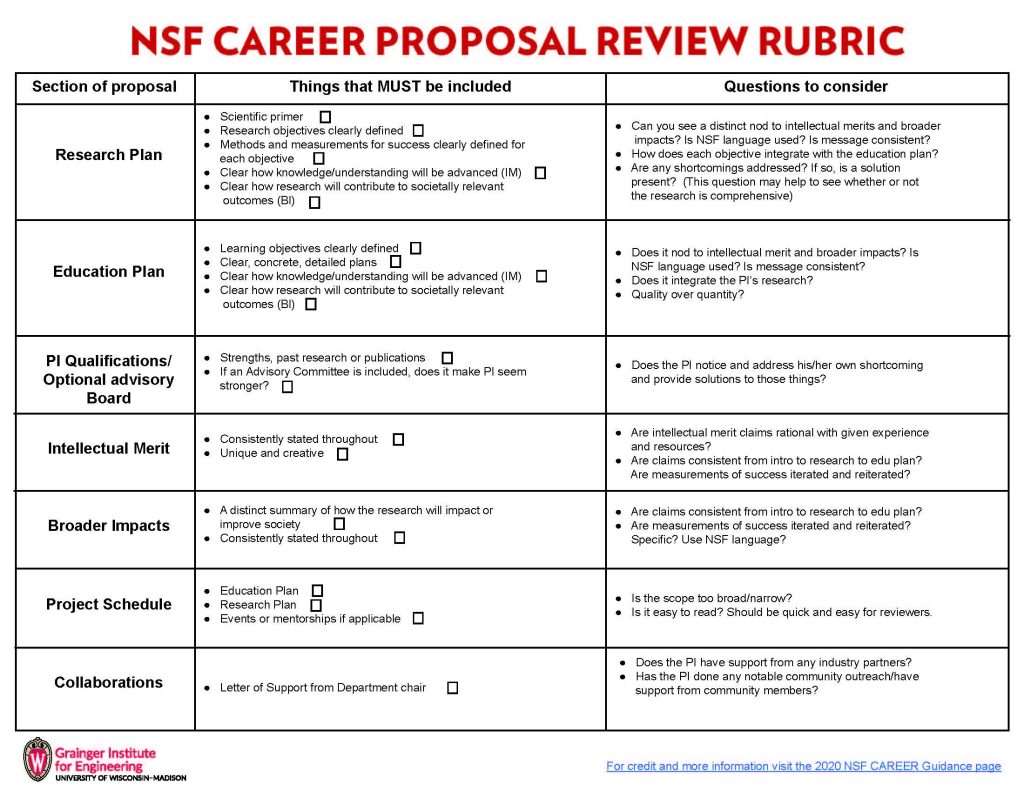
Project Description Review Rubric
American Association for the Advancement of Science "Top Ten Lessons Learned from 10,000 Proposal Reviews" Webinar
Top Ten Criticisms
- Proposal not relevant to funding agency’s priorities and requirements
- Solutions
- Explain in writing, in the proposal, how the project fully meets the requirements and priorities of the competition
- Requirements = Compliance
- Priorities = speak to the needs of the program and agency (explicit and implied)
- Some successful proposals include a section titled Funding Priorities
- Don’t make the reviewers hunt for critical information
- Talk to program officers!
- Don’t try to fit something into a program that’s not a good fit
- Solutions
- Proposed work cannot be completed in the time allowed
- Solutions
- Provide a visual timeline (Gantt chart) showing all key steps and the time required for each step
- Visual representation provides clarity – significant advantage! surprising how many proposals do not include this
- Mapping out the project can also help you figure out what’s really feasible
- Discuss backup options (what challenges/setbacks might you come across and what’s your plan for addressing them, or how does this affect the timeline?)
- Solutions
- Proposed work does not contribute to important questions in the field of research
- Solutions
- Use the Introduction and Background section(s) to cite recent publications and illustrate how the project addresses gaps in knowledge or tests an important hypothesis
- Start with the big picture and be strategic with your Introduction
- Keep your 2 audiences in mind:
- program officer – broad disciplinary knowledge
- review panel – not exactly experts in the topic; know technical details, but need context/background
- Speak to broader audience beyond the people in your lab
- Solutions
- The methodology is not clearly explained, is missing key details, is out of date
- Solutions
- Publish your methods and cite your method publications
- Cite the methods of others and explain any modifications you will make
- Explain every detail relevant to obtaining publishable data
- Explain statistical methods where relevant (especially in biosciences)
- If you use an older method, compare it to the current approach; explain why you chose it
- Solutions
- Proposed work cannot be carried out with the funding requested
- Solutions
- When developing the proposal, match the budget carefully to research plan
- Always include a budget narrative (not just the budget table)
- Usually formally required, but the quality is key
- Opportunity to expand on plan and needs and important details
- Show guaranteed sources of outside support (obtain commitments of cost-sharing in writing)
- Without documentation, it becomes a source of doubt
- Solutions
- The team is well qualified but missing expertise required for parts of the project
- Solutions
- Make sure team CVs illustrate qualifications for all project elements
- Add collaborators with needed qualifications
- Show preliminary data to illustrate ability to achieve goals
- Publish previous results in international peer-reviewed journals to establish qualifications
- Write the letter of support for the collaborator to give them a starting point so key elements of their contribution are included (make sure there are no miscommunications)
- Collaborators generally welcome this help
- Solutions
- Panelist is frustrated looking for key information; panelist misreads or misunderstands proposal
- Solutions
- Provide clear section headings and format the proposal consistently
- Break the proposal into smaller sections and subsections and use descriptive headings
- Repeat key points in the proposal narrative so they are not lost
- Use tables and figures to illustrate important concepts
- Reviewers are busy; they need your help (and it helps you)
- Look at all pages of proposal at a distant (e.g. pull up view of all 15 pages of PD)
- Allows you to see breakdown of the writing; can see if there are many pages of text without clear headings, sections, subsections, etc.
- Step back to look at structure, organization, etc.
- Solutions
- The outcomes described are not all discussed in the research plan. Research plan does not describe how some goals will be met.
- Solutions
- Carefully read the proposal draft: if a goal is not discussed in the research plan, revise the research plan or delete the goal
- Sometimes you’ll need to reduce the scope of the project to fit the time and budget available
- Use the conclusion of the proposal to describe other goals for future funding
- Solutions
- Proposal is poorly written, full of errors that indicate careless editing. Low quality of writing suggest that PI may not be successful publishing results.
- Solutions
- Have other good writers read the draft
- We can’t always catch our mistakes easily
- Develop the draft in advance; don’t look at it for a week; read it again very carefully with “fresh eyes”
- Be very detailed in polishing spelling, grammar, and appearance
- We are always practicing to improve our writing
- “If you can’t explain it simply, you don’t understand it well enough.” -Albert Einstein
- Solutions
- Proposal is reasonable, well written, and makes a scientific contribution but it is not interesting or exciting work. It is not competitive.
- Solutions
- Be sure to illustrate the broad importance of your work. What is the impact? Are there important applications possible?
- Discuss the plausible benefits in the Introduction and in the Conclusion of the proposal
- Some successful proposals include a separate page on “Projected Impacts”
- NSF: bit.ly/broaderimpacts19
- Solutions
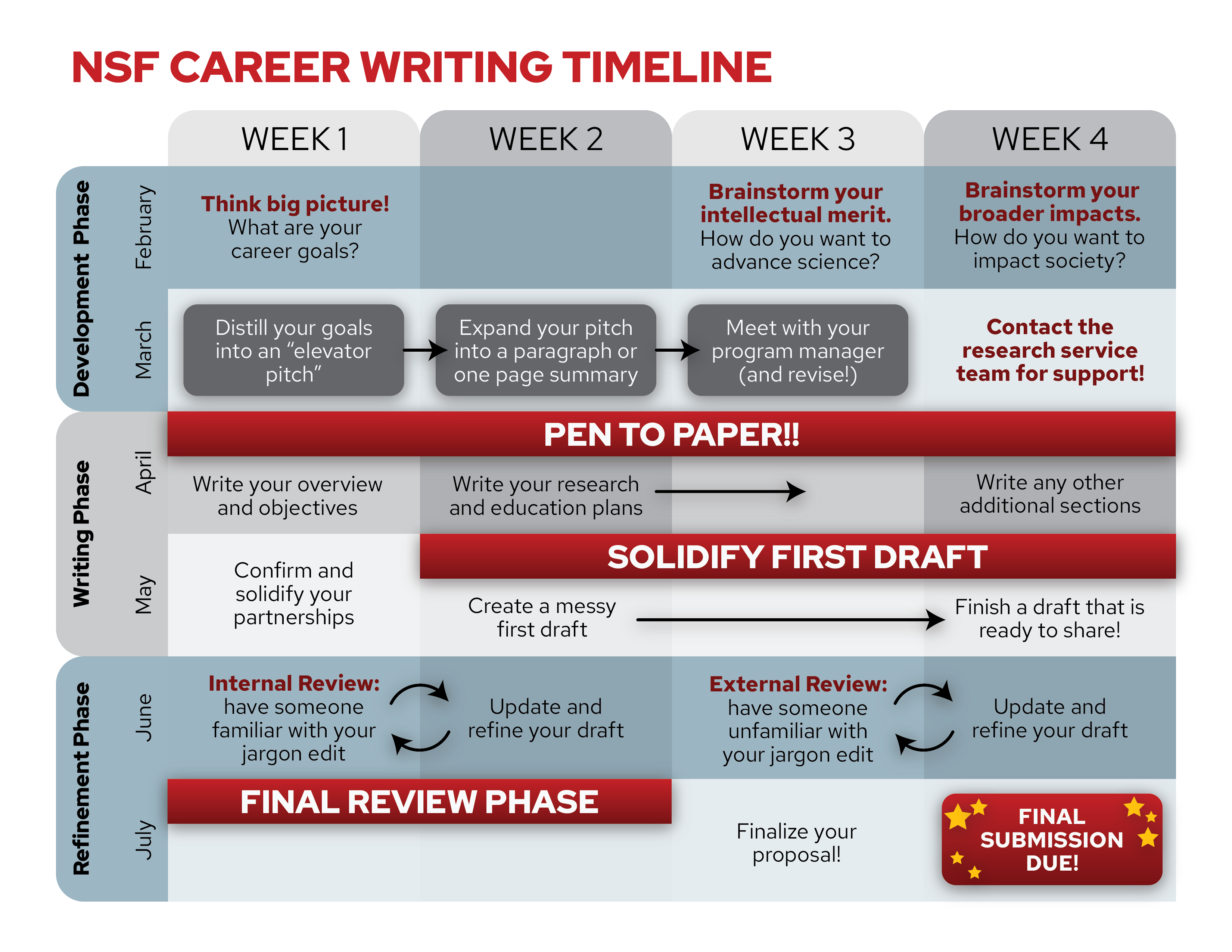
Suggested Writing Timeline
Public Winning CoE Abstracts
Winning Abstracts from 2010-2021:
Broader Impacts
The broader impacts plan is an integral portion of all NSF proposals, and the NSF CAREER proposal is no exception. According to NSF,
Broader impacts is the potential to benefit society and contribute to the achievement of specific, desired societal outcomes.
NSF has identified 9 categories of Broader Impacts, including the: full participation of women, person’s with disabilities, underrepresented minorities in STEM; improved STEM education and educator development at any level; increased public scientific literacy and public engagement with science and technology; improved well-being of individuals in society; development of a of a diverse globally competitive STEM workforce; increased partnership between academia, industry, and others; improved national security, improved national security; increased economic competitiveness of the United States; and enhancement infrastructure for research and education.
See NSF’s Broader Impacts Guidance
Given that Broader Impacts is such an essential part of the NSF CAREER Proposal, we have a
- 2020 NSF CAREER Webinar (12:50)
- 2022 IED Discussion: Integrating DEIA into your NSF Career Plan
- 2022 Broader Impact Slides (Session not Recorded)
The Broader Impacts website has a litany of resources across campus to help you develop your broader impacts identity, integrate broader impacts into your research, and create lasting, authentic partnerships to achieve your goals.
Read more
The Broader Impacts Toolkit includes guiding principles, a planning checklist, the BI Project Rubric, and the BI Wizard. The BI Wizard walks you through the key steps for building strong partnerships and effective plans.
Read more
WARF is an excellent resource for faculty to leverage at UW. Specifically, programs like the Wisconsin Science Festival, Afterschool expeditions, and Saturday Science can be great partners for Broader Impacts plans.
Read moreResearch Administration
This is an accordion element with a series of buttons that open and close related content panels.
NSF Career Proposal Checklist
Updated May 2024
Research Mentoring Plan
Updated May 2024
Budget Justification Template
Updated May 2024
Specific Research Administration Webinar Segments
Our past webinars are great ways to learn about research administration’s expectations and support opportunities, specifically in:
NSF CAREER Solicitation
CAREER: The Faculty Early Career Development (CAREER) Program is a Foundation-wide activity that offers the National Science Foundation’s most prestigious awards in support of early-career faculty who have the potential to serve as academic role models in research and education and to lead advances in the mission of their department or organization. Activities pursued by early-career faculty should build a firm foundation for a lifetime of leadership in integrating education and research. NSF encourages submission of CAREER proposals from early-career faculty at all CAREER-eligible organizations and especially encourages women, members of underrepresented minority groups, and persons with disabilities to apply.
FAQs for the Career Program Solicitation
ELIGIBILITY
-
- How is eligibility for a CAREER award certified?
- The CAREER Program Solicitation states that a proposer must have the title of assistant professor or equivalent. I am non-tenured but hold the title of associate professor. May I apply?
- The CAREER Program Solicitation requires that I hold a doctoral degree by the proposal submission deadline. I have defended my thesis but will not have my diploma by the submission deadline. May I apply to the CAREER Program this year?
- I am an untenured assistant professor and have received a notification for tenure and/or promotion to be effective later in the fall. Am I eligible to apply this year?
- I held a tenured position at my former organization, but I am not in a tenured position now. Am I eligible to apply?
- I received my Doctorate six years ago. Am I eligible to apply?
- I am not a U.S. Permanent Resident or U.S. Citizen or U.S. National. Can I apply to the CAREER Program?
- Am I eligible to apply if I work at a non-degree-granting organization such as a museum, observatory, or research lab?
- Am I eligible if I work at a 2-year college or a community college?
- I am a new faculty member at an institution that qualifies as an undergraduate institution under the provisions of the Research in Undergraduate Institutions (RUI) Program Solicitation. Is it possible to apply for the CAREER Program under the RUI provisions?
- If I have received funds from the Federal Government to perform research, may I still apply for a CAREER award?
PROPOSAL PREPARATION, BUDGET PREPARATION, AND SUBMISSION
PROPOSAL PREPARATION
-
- What are common reasons for which CAREER proposals are returned without review?
- I have two possible projects. May I submit two CAREER proposals?
- May I submit a CAREER proposal and another proposal on a different topic to NSF in the same year?
- May I submit a CAREER proposal and a regular research proposal on a similar topic to NSF at the same time?
- What are the expectations for the level of activities in the education component?
- What documentation should I submit to show any collaborative efforts?
- I have additional information posted on my website I would like the reviewers to see. May I refer readers to my web site within the Project Description?
- I would like to be considered for a PECASE award. What is the process?
- If I held an NSF postdoctoral fellowship, do I need to include a “Results from Prior Support” section?
BUDGET PREPARATION
PROPOSAL SUBMISSION
-
- What if my proposal is submitted after the deadline?
- My proposal seems to fit in two different programs. What should I do to indicate which Program(s) I want to consider my proposal?
- I am having problems submitting my proposal and the CAREER deadline is almost here. Whom should I contact?
- I just noticed a major problem with my CAREER proposal. The CAREER deadline has not passed so can I fix the problem?
- Do I submit a proposal to just the CAREER program solicitation or to a particular program at NSF and how do I decide to which program I should submit my CAREER proposal?
ANNOUNCEMENT OF CAREER AWARDS
AWARD ADMINISTRATION
- Are the reporting requirements for CAREER awards the same as for other NSF awards?
- What types of supplemental funds are available for CAREER awards?
- What happens to my CAREER award if I leave my academic appointment for a position that is tenured, tenure-track, or tenure-track-equivalent at a CAREER-eligible institution?
- What happens to my CAREER award if I leave my academic appointment for a position that is neither tenured, tenure-track, nor tenure-track-equivalent; or for a position at a new organization that is not CAREER-eligible?
- What happens to my CAREER award if I am unable to continue the project due to health/medical/family or other personal issues?
NSF Proposal and Award Policies and Procedures Guide
Contacting your Program Manager
Contacting your Program Manager early will set you up for proposal success. Our team suggests preparing an elevator pitch, which integrates your broader impacts goals and research problem and then expanding your ideas into a paragraph or page long outline further explaining your plans.
When discussing your idea for your NSF CAREER plans,
- Use your expanded elevator pitch to outline your ideas and objectives. Check if your plan fits within the agency’s priorities and is relevant to their mission.
- Ask the Program Manager if there are any noticeable shortcomings within your outline. What things typically keep proposals from getting funded, in their experience?
- Before meeting with the Program Manager, research the agency. Make sure to ask questions to clarify any questions that may arise and know your funding policy.
- Clarify how the proposal will be reviewed. Who will review them? How many people will review them? How are reviewers chosen? Is it Ad Hoc type? A panel?
This is an accordion element with a series of buttons that open and close related content panels.
Developing your Elevator Pitch
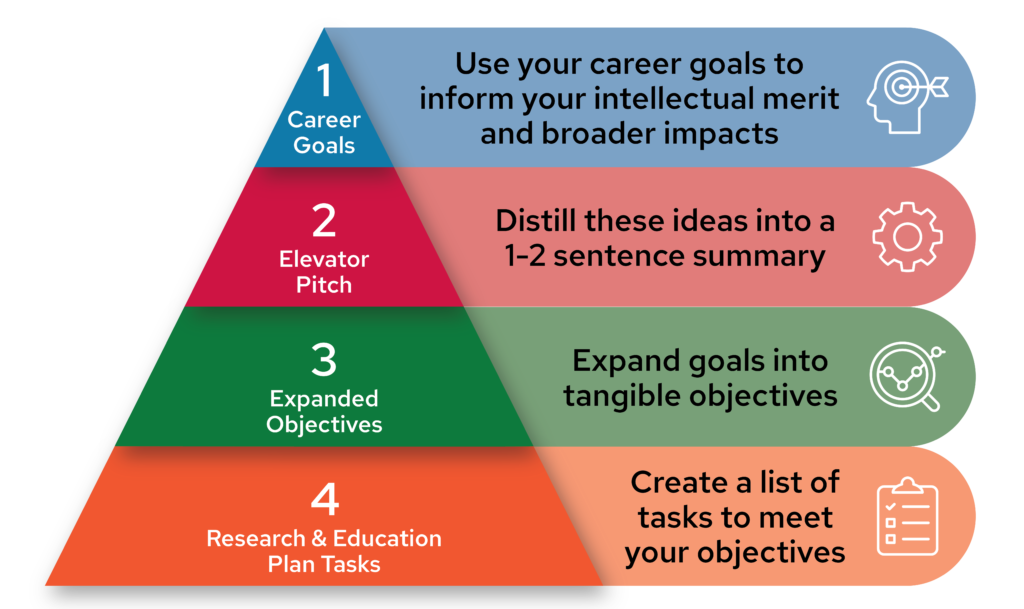 Writing an elevator pitch encompassing your career, intellectual merit, and broader impacts goals helps you focus the main ideas of your proposal to better communicate your ideas to relevant stakeholders. Within the context of the research problem you are solving and your intellectual merit and broader impact goals, write a succinct statement to guide your proposal ideas. This is your elevator pitch.
WRITE: My research goal is… and to reach my goal…
LIMIT: Fit your statement into 25 words or less
REFINE: Your elevator pitch can be flexible and adaptable as you develop your proposal
When contacting your Program Manager, expand your elevator pitch into a paragraph or page-long outline.
Specific Webinar Segments with Guidance
You can find advice on contacting your program manager both from past webinar developers and NSF CAREER winners with experience in doing so:
- 2023 Webinar (35:00)
- 2020 Webinar: General Advice on Contacting your Program Manager (4:35)
- 2022 NSF CAREER Panel (30:51)
Additional Early Career Opportunities
This is an accordion element with a series of buttons that open and close related content panels.
DoD Defense Advanced Research Projects Agency (DARPA) Young Faculty Awards (YFA)
DARPA’s Young Faculty Award aims to expose young faculty and researchers to DoD and National Security challenges and needs, providing high-impact funding to enable transformative DoD capabilities.
Eligibility Information: Proposers must be one of the following:
- Current tenure track assistant/associate professors
- Current tenured faculty within 3 years of tenure date
- An equivalent at a non-profit research institution within 12 years of the receipt of their Ph.D
Funding: $500,000 over 24-months. Can be nominated by Program Manager for an additional 12 month period with $500,000 max in extra funding.
Due Date: Past due for the 2024 DARPA YFA, 2025 DARPA YFA Executive Summary Anticipated Due December 2024.
Topic Areas:
- 3D Microphysiologic Systems
- Spatially Precise Microenvironments for Localized Therapeutic Intervention
- Rapid Characterization and understanding of cell binding and entry by novel viral pathogens
- Outcome Selection through nontraditional receptor modulation
- Biohybrid additive manufacturing of strong, flexible optical elements
- Multiscale modeling of microbial communities
- Decentralized foundation models from small data
- Compilation for Integrated Heterogeneous systems
- For Real Large Language Models (FR LLMs)
- Casual and Mechanistic Explanations of Large Language Models
- Deployable Radiators for Small, High Power, Low Earth Orbit Spacecraft
- Optical Coupler Arrays
- Photonic Integrated Generators of Multiphoton Entanglement
- Hardware/Software Fault Injection
- Advanced Structural Energetics
- Beyond line-of-sight Power Beaming
- Gas Surface Interactions in Very Low Earth Orbit
- Novel Underwater Propulsion
- Light-Matter Hybrids in the Large Cooperativity Regime
- Poetics of authenticity in human-AI generated content
- 3-Domain Integration
- Electromagnetic Interference Safeguards Secured by Ionics
- Exploring the Limits of Reinforcement Learning Explain ability
- NEW – DSO Open YFA Topic for: Novel Materials and Structures, Sensing and Measurement, Computation and Processing, Enabling Operations, Collective Intelligence, and Emerging Threats
Key Review Criteria:
- Overall scientific and technical merit
- Potential contribution and relevance to DARPA’s mission
- Cost-realism
DoD Air Force Office of Scientific Research (AFOSR) Young Investigator Research Program (YIP)
The program objective is to foster creative basic research in science and engineering; enhance early career development of outstanding young investigators; and increase opportunities for the young investigator to recognize the Air Force and Space Force mission and related challenges in science and engineering.
Eligibility Information:
- Received PhD or PhD equivalent within seven years of applying.
Funding: Most YIP awards are funded up to $150,000 per year for three years, for a total of $450,000. Each three year budget must not exceed $150,000; regardless if the total budget is $450,000. Exceptional proposals will be considered individually for higher funding levels and/or longer duration.
2024 Due Dates:
- The 2024 FOA will be released March 4, 2024
- Whitepaper submission will be due April 15, 2024
- Full proposals will be due June 17, 2024
Research Areas:
- Aerospace Composite Materials
- Aerospace Materials for Extreme Environments
- Agile Science for Test and Evaluation
- Astrodynamics
- Atomic and Molecular Physics
- Biophysics
- Cognitive and Computational Neuroscience
- Computational Cognition and Machine Intelligence
- Computational Mathematics
- Condensed Matter Physics
- Dynamic Data and Information Processing
- Dynamical Systems and Control Theory
- Electromagnetics
- Energy, Combustion, and Non-Equilibrium Thermodynamics
- GHz-THz Electronics
- High Energy Radiation Matter Systems
- High-Speed Aerodynamics
- Human Performance and Biosystems
- Information Assurance and Cybersecurity
- Mathematical Optimization
- Mechanics of Multifunctional Materials and Microsystems
- Molecular Dynamics and Theoretical Chemistry
- Multiscale Structural Mechanics and Prognosis
- Natural Materials and Systems
- Optoelectronics and Photonics
- Organic Materials Chemistry
- Physics of Sensing
- Propulsion and Power
- Quantum Information Sciences
- Science of Information Computation, Learning, and Fusion
- Space Biosciences
- Space Physics
- Trust and Influence
- Ultrashort Pulse Laser-Matter Interactions
- Unsteady Aerodynamics and Turbulent Flows
Key Review Criteria:
- Principal Review Criteria:
- The technical merits of the proposed research and development
- Potential relationship of the proposed research and development to DoD’s missions
- Additional Evaluation and Selection Criteria
- The likelihood of the proposed effort to develop new research capabilities and broaden the research base in support of U.S. national defense
- The applicant, principal investigator, team leader(s). and key personnel qualifications, capabilities, related experience, facilities, or techniques, or a combination of these factors, that are integral to achieving United States Air Force objectives
DoD Army Research Office (ARO) Early Career Program (ECP)
ECP awards are funded by the Army to support early career scientists and engineers who show exceptional ability and promise for conducting basic research. The objective of the ECP award is to foster creative basic research in science and engineering; enhance development of outstanding early career investigators; and increase opportunities for early career investigators to pursue research in areas relevant to the Army.
Eligibility:
- For faculty who have held a tenure track position for fewer than five years
Funding: ECP awards will not exceed $120,000 per year for 3 years
Due Date: Open (as part of ARL Nov 2022-Nov 2027 Broad Agency Announcement)
Research Areas:
- Advanced Learning-Enabled Intelligent Cyber Physical Systems
- Atomic and Molecular Physics
- Biochemistry
- Biomathematics
- Bionic Electronics
- Complex Dynamics and Systems
- Computational Mathematics
- Condensed Matter Physics
- Earth Materials and Processes
- Electrochemistry
- Electronic Sensing
- Environmental Chemistry
- Fluid Dynamics
- Genetics
- Information Assurance
- Information Processing and Fusion
- Knowledge Systems
- Materials Design
- Mechanical Behavior of Materials
- Microbiology
- Modeling of Complex Systems
- Modern Optics
- Multi-Agent Network Control
- Neurophysiology of Cognition
- Optoelectronics
- Physical Properties of Materials
- Polymer Chemistry
- Quantum Information Science
- Social and Cognitive Networks
- Solid Mechanics
- Solid State Electronics and Electromagnetics
- Support to ARL Foundation Research Competencies
- Synthesis and Processing of Materials
- Wireless Communications Networks
Key Review Criteria
- The overall scientific and/or technical merits if the proposal
- The potential contributions of the effort to the Army mission
- The qualifications, capabilities, and experience of the proposed PI, team leader, or other key personnel who are critical to the achievement of the proposed objectives
- Long-term commitment by the institution of higher education to the early career investigator and the proposed research
DoD Office of Naval Research (ONR) Young Investigator Program
The objectives of this program are to attract outstanding faculty members of Institutions of Higher Education (hereafter also called “universities”) to the Department of the Navy’s Science and Technology (S&T) research program, to support their research, and to encourage their teaching and research careers.
Eligibility
- Hold a first or second full-time tenure-track or tenure-track-equivalent faculty position at that university, AND
- Received his/her doctorate or equivalent degree within the past seven years.
Funding: Typical awards are $750,000 over a 36-month period of performance. Applicants may request up to $250,000 for each 12-month interval.
Due Date: Anticipated July/August 2024
Check updated FOA for 2025 research areas, but ONR has five main departments:
- Command, Control, Computing, Communications, Cyber, Intelligence, Surveillance, Reconnaissance, and Targeting
- Ocean Battlespace Sensing
- Sea Warfare and Weapons
- Warfighter Performance
- Naval Air Warfare and Weapons
Key Criteria:
- Technical Merit
- Naval Science and Technology Priorities
- Past Performance
- Long-term institutional commitment
- Cost Realism
DoE Early Career Research Program
The purpose of this program is to support the development of individual research programs of outstanding scientists early in their careers and to stimulate research careers in the areas supported by SC. SC’s mission is to deliver the scientific discoveries and major scientific tools to transform our
understanding of nature and advance the energy, economic, and national security of the United States.
Eligibility
- untenured, tenure-track assistant or associate professor
Funding: approximately $875,000 over five years
Due Date:
- 2024 pre award already due (required)
- Pre award anticipated due January 2025
- Full proposal anticipated due April 2025
Early Career Award
- Scientific and/or Technical Merit of the Project;
- Appropriateness of the Proposed Method or Approach;
- Competency of Applicant’s Personnel and Adequacy of Proposed Resources;
- Reasonableness and Appropriateness of the Proposed Budget;
- Quality and Efficacy of the Promoting Inclusive and Equitable Research (PIER) Plan.
- PROMOTING INCLUSIVE AND EQUITABLE RESEARCH (PIER) PLAN
All new and renewal applications must provide a Promoting Inclusive and Equitable Research (PIER) Plan as an appendix to the project narrative. Please read the instructions in Section IVand the associated review criteria in Section V.
- PROMOTING INCLUSIVE AND EQUITABLE RESEARCH (PIER) PLAN
- Relevance to the mission of the specific program (e.g., ASCR, BER, BES, FES, HEP, NP,
DOE IP, or ARDAP) to which the application is submitted; and - Potential for leadership within the scientific community
Topic Areas:
- Advanced Scientific Computing Research (ASCR);
- Basic Energy Sciences (BES);
- Biological and Environmental Research (BER);
- Fusion Energy Sciences (FES);
- High Energy Physics (HEP);
- Nuclear Physics (NP);
- Isotope Research and Development (R&D)
- Production (DOEIP);
- Accelerator R&D and Production (ARDAP).
National Institutes for Health Loan Repayment Program
The NIH Loan Repayment Programs (LRPs) are a set of programs established by Congress and designed to recruit and retain highly qualified health professionals into biomedical or biobehavioral research careers. The escalating costs of advanced education and training in medicine and clinical specialties are forcing some scientists to abandon their research careers for higher-paying private industry or private practice careers.
Eligibility
Funding: Up to $50,000 per year in student loan repayment (college, graduate, and PhD all typically eligible)
Due Date: Online Application period for Extramural Awards (meaning not employed by NIH) Anticipated September-November 2024
Two Categories:
Select “Mentored Researcher”, if one or more of the items listed below apply to you:
- You receive early-stage awards, training awards, or funding that lists a mentor or supervisor;
- Your research is partially funded by another investigator’s grant(s);
- Your research is conducted entirely in another investigator’s assigned space;
- You are not allowed to apply as the PD/PI of an NIH research grant (e.g., R01, a
subproject leader on a Program Project (P01) or Center Grant (P50)); - You lack other rights and privileges of faculty, such as attendance at faculty meetings; and/or
- You are receiving support and protected time from a fellowship or career development award.
Select “Independent Researcher”, if one or more of the items listed below apply to you:
- You are eligible to apply for independent research funding as the PD/PI of a Federal or
non- Federal research grant. - You have a full-time faculty position;
- You received a start-up package for support of your independent research;
- You have research space dedicated to your own research;
- You may be the responsible supervisor for graduate students, and/or hire technical support
or postdoctoral fellow
Note: You are strongly encouraged to consult with your research institution, as well as the appropriate
NIH Institute/Center LRP Program Officer to determine which category best describes your status.
Extramural Research Categories:
- Clinical Research
- Pediatric Research Health Disparities Research
- Contraception and infertility Research
- Clinical Research for Individuals from Disadvantaged Backgrounds
- Research in Emerging Areas Critical to Human Health
UW Institute for Clinical and Translational Research (ICTR) Career Development Awards
Career Development Awards: KL2 Scholars Program, the TL1 Postdoctoral Training Program, and the TL1 Predoctoral program, ADEPT, AHEAD, and Stride. Awards made possible with the support of NIH National Center for Advancing Translational Sciences, the Wisconsin Partnership Program of UW’s SMPH, and other institutional partnerships in Madison and Marshfield.
Current Research Areas:
- Advancing Health Equity and Diversity
- Advancing Translational Research and Science
- Clinical and Community Outcomes Research
- Collaborative Health Equity Research
- Dissemination and Implementation Research
- Evidence to Implementation
- Learning Health Systems
- Marshfield Clinic-UW Collaborative Research
- Stakeholder and Patient Engaged Research
- Translational Basic and Clinical Research
WARF Accelerator
WARF Accelerator projects aim to advance and de-risk high potential technologies. They provide resources for inventorsto the most commercially promising and urgent technologies and advance them closer to the marketplace.
Market Focuses:
- Clean Tech
- Computer Science and Engineering
- Food and Agriculture
- Health Care
- Research Tools
Office of the Vice Chancellor for Research (OVCR) Research Fall Research Competition
Eligibility: This competition is for tenured professors and associate professors, tenure-track assistant professors, and permanent PIs at the University of Wisconsin–Madison.
To make the best use of the funds available to the Committee, an important goal is that Research Committee investments lead to continued external funding in disciplines where that is possible. Senior faculty, and junior faculty who have received significant prior fall research competition funding and/or significant VCGRE funding, are encouraged to submit proposals that serve as backup support for external grant applications. Alternatively, funding may be requested for pilot studies in new research directions, with the goal of developing preliminary data that will increase the likelihood of competitive extramural support. See the FAQs below for further information on priorities for funding within each division. Information about the granting procedures of various federal and non-federal agencies is available from the Office of Research & Sponsored Programs.
Divisions include: Arts and Humanities, Biological Sciences, Physical Sciences, and Social Sciences.